
WASTEWATER MEASUREMENT RESOURCES
-

It seems that everywhere that you go in the water industry at the current time, somebody is talking about digital transformation…or if we go back five minutes, it was Water 4.0…and 10 minutes ago (it seems), it was “smart water.” These are all very well used buzzwords that the industry is destined to think about for a short-term and then promptly forget about. In reality, though, we as an industry have been hit by a number of different concepts for a number of different technological aspects for a good number of years now. For almost as long we have had a term for all of this — “widgets.”
-

Discover how the use of new smart technologies helps the Clean Water Project team better protect neighborhoods and local waterways through real-time monitoring of sewer system overflows, further driving digital transformation in one of America’s most historic cities.
-

Large utilities need to maintain high levels of service when it comes to water and wastewater systems. If they do not they risk failures, fines, and costly reactive maintenance. This specific organization was looking to find a solution that could improve decision support models and monitoring data integrity.
-

The City of Atlanta Department of Watershed Management (the City) engaged Optimatics and Stantec Consulting to develop optimized Long-Term Control Plans (LTCPs) for three of their sewersheds using the Optimizer platform. The City of Atlanta DWM is a large utility in the Atlanta area, servicing 1.2 million customers. The utility places strong emphasis on sustainable stormwater management practices and utilizes green infrastructure throughout its networks.
-
The majority of the water in the city of Simi Valley, California, is provided by Ventura County Waterworks District 8, serving approximately 26,000 metered connections — 22,000 of which are now read by Neptune’s R900® System.
-

The City of Shelby, Ohio recently upgraded its activated-sludge wastewater treatment plant to double its capacity to 5 MGD, while expanding its capability to treat and disinfect combined high-volume stormwater and wastewater flows generated by wet-weather conditions.
-

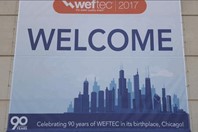
For the second straight year, the Water Environment Federation Exhibition and Conference (WEFTEC) came to McCormick Place in Chicago, returning also to the city which launched WEFTEC 90 years ago. As always, it was a showcase of the latest technologies and ideas available in the water/wastewater industry, but each show also has its own "feel" that reflects the times.
-
 Ratio")
The food-to-microorganism (F-M) ratio is a process control numeric value advantageous to determine the proper number of microorganisms for the biological treatment process. The solution of calculating F-M ratio uses the influent volume of wastewater into an activated sludge system (flow MGD), incoming carbonaceous biochemical oxygen demand (CBOD) (mg/L) concentration into the aeration tank, mixed liquor volatile suspended solids (MLVSS) concentration (mg/L), and quantity (in gallons) of the respective aeration system.
-

Technology like advanced process control systems can streamline operations, create opportunities to lower costs and emissions, and ensure effluent quality meets the highest standards. Research also indicates that implementing an appropriate control strategy can help reduce N2O emissions.
-
If you feel like you have too much data but not enough understandable or usable information, fine-tuning data collection and funneling it into an integrated data management system may be the way to become more proactive and make better decisions.




WASTEWATER MEASUREMENT VIDEOS
KROHNE has been manufacturing flow meters for over 100 years. Today take a look at what KROHNE has to offer the water and wastewater markets for flow measurement.